Welcome!

Welcome to our blog! We are excited to share pictures, stories and videos about our nature programs to you. Stay tuned for posts for all of our summer camp locations

Tuesday, January 3, 2012

Winter Wonder Camp

The camp was a fantastic experience for both teachers and campers. It was a great way to flex some muscles and imaginations during the holidays!  We had beautiful weather and saw many kinds of birds at our new feeder station and on the trail: dark-eyed juncos, eastern bluebirds, red bellied woodpeckers, blue jays and hundreds of robins. Even our boisterous group of 13 three-five year olds got to see some wildlife during our winter scavenger hunt!  Our older red foxes became especially tuned in to nature by paying close attention to the day length and bird sounds. On the last day during snack, they all started squeezing our toy Audubon birds and quizzing each other (and me!) on bird songs!  Both groups made fantastic shelters for their 'jello' babies (jello mixed with water in a cup and left over night in a natural shelter).

Despite cold temperatures, all jello babies survived the night and were still liquid thanks to some hard working kids!  To offset the lack of snow, foxes grew their own snow crystals and took home snow catching "kits" to be kept cold until the next snowfall.  Both groups enjoyed fun outdoor games and creating yummy shelters to eat for their teddy bears.


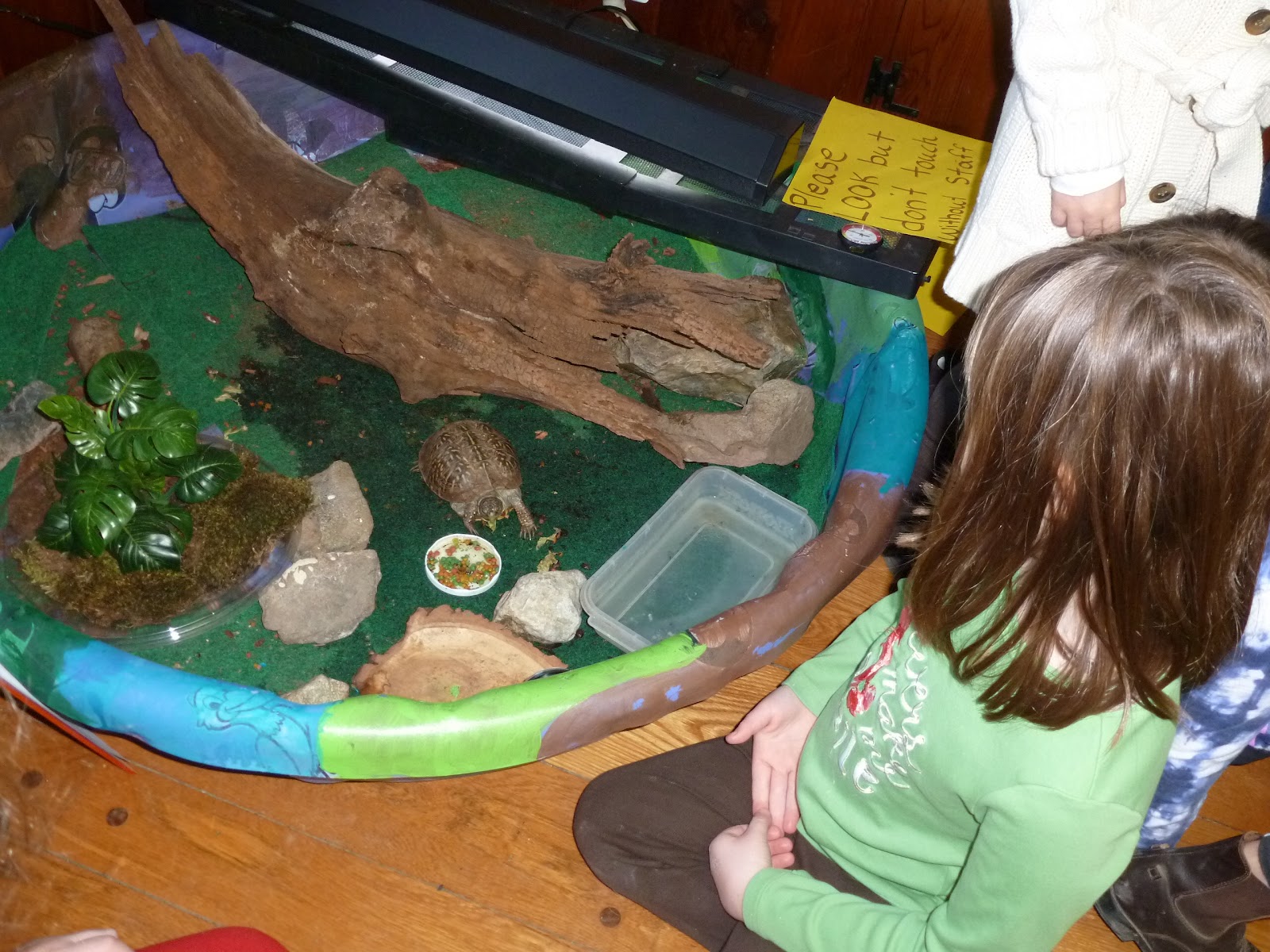
For the first time at camp, we scheduled in "exploring time." As the center grows, kids seem to have an affinity for just exploring. It seemed only natural to me to officially schedule time for this into the schedule. After explaining the rules, the kids took off and had a blast bird watching at our new feeder area, looking at our new live crickets, dragonfly nymphs, snails and box turtle, writing or drawing in our turtle and bird watching journals, reading books, playing with our toy bird stuffed animals and animal puppets, drawing on the chalkboard, examining feathers and bug books with magnifying glasses and touching the real stuffed animals and skulls and shells.  After snack time, all campers got to feed Herman the Worm.  I have a few more ideas to implement this winter as well: place a baby monitor at the bird feeder station to hear the birds, create a sandbox animal track play area and re-do our touch box.


Thanks for supporting us for this new camp! We couldn't have done it without you! Stay tuned to more new programs in the spring!

Miss Marissa
Making graham cracker shelters for teddy bears


Jello Baby Shelter

Jello baby shelter


Enjoying the sunshine

Mouse vs fox game

Feeding time for BJ

Penguin Game!

Bird watching

Hiking

Mouse vs fox game!

Making re-used bird feeders out of egg cartons-YUM!

Exploring the crickets

Future scientists

Me taking a break

Taking a break during a long hike

Hike!

Looking for birds

Tuesday, September 6, 2011

Meet BG the Box Turtle!

Come to Whittemore and meet our newest resident, Brown Green (or BG), a female eastern box turtle! A local boy named Alexandro Cosmo donated him to us because his family was moving to Italy and he couldn't take BG with him. We are lucky to have BG and are in the process of creating a new habitat for him, out of a baby pool. If you stop by with food (fruits, veggies, worms, slugs-yum!) you can even feed her. You can also meet her at the Tewksbury Harvest Festival on 9/24.

BG will also serve as an ambassador to all wild box turtles. If you see a box turtle in the wild, never take it home! BG was bred in captivity.


Here is some information on Eastern Box Turtles from Davidson College:


Eastern box turtles are amazingly versatile animals and inhabit a wide variety of habitats from wooded swamps to dry, grassy fields. Although these turtles can live in a variety of different habitats, they are most abundant and healthy in moist forested areas with plenty of underbrush. Although not aquatic, box turtles will often venture into shallow water at the edge of ponds or streams or in puddles. Box turtles do not travel far, usually living within an area less than 200m in diameter. In cold climates they hibernate through the winter in loose soil at a depth of up to two feet.
Box turtles are omnivores in the broadest sense of the word. They will eat almost anything, animal or plant, that they can fit in their mouth. Intriguingly, it is thought that young box turtles are primarily carnivorous and that as they grow their diet shifts more and more towards plant material. Favorite foods include almost any insect (although they seem to particularly relish worms and slugs), virtually any fruit or berry, mushrooms, a variety of vegetable matter, and even carrion. Interestingly, box turtles are even able to eat many mushrooms that are toxic to humans.
Although box turtles are still fairly common over much of their range, their future is uncertain. Box turtles are slow growing, have few young, and have exhibited delayed sexual maturity. These qualities make them particularly susceptible to damage due to human activities. First and foremost among problems faced by box turtles is habitat destruction and fragmentation. Fragmentation is defined as the process by which natural or seminatural habitats are seperatated from similar habitats by land that is used by humans. As areas of suitable habitat become fewer and farther between, box turtle populations will decline and individual populations will become increasingly vulnerable to extinction. Confined to smaller areas, the turtles will have an increasingly difficult time finding food or mates. These small, isolated populations may suffer from inbreeding and other genetic problems. Box turtles may also wander out of their isolated habitats into the matrix (the land used by humans), where they are particularly susceptible to accidental death due to humans. Each year countless box turtles are hit by cars or trains when they attempt to cross roads or railroads. Others are accidentally killed by lawn mowers, tractors, and farm equipment.
Another concern is the capture of box turtles for the pet trade. The impact of taking turtles from the wild can be devastating to local populations. Over the span of their lifetime, female turtles will lay hundreds of eggs, but only 2-3 of these offspring will survive to adulthood. These offspring will eventually replace their elderly parents, allowing the population to remain at a stable size . But, if box turtles are taken from the wild to become pets, or are killed by human activities, they are removed from the overall breeding population, the number of offspring drops, and the overall population declines. Additionally, box turtles have a homing instinct that causes them to try to return to the place of their birth if they are moved. As a result, when box turtles that have been taken as pets are returned to the wild, they will head straight for their natal grounds. This journey causes the turtles to encounter many dangers, such as roads, predators, and humans. For these reasons, if you are looking for a pet, you should try to find a captive-bred animal or consider a different pet. (Davidson College http://www.bio.davidson.edu/people/midorcas/research/Contribute/box%20turtle/boxinfo.htm)

Monday, August 15, 2011

Roving Rangers and Junior Naturalists at Whittemore!

Parachute Butterfly Metamorphosis

He's inside the egg, about to hatch out as a caterpillar!

Inside the GIANT egg

Creating a woodland collage


Inside the giant egg!

Shelter building! Wow, I'd sleep in there

Hiking!


Face painting Mr. Nick using rocks

Look at those beautiful faces

What did we find?

The shelter is completed!

2nd Jurassic and Paleo at Whittemore

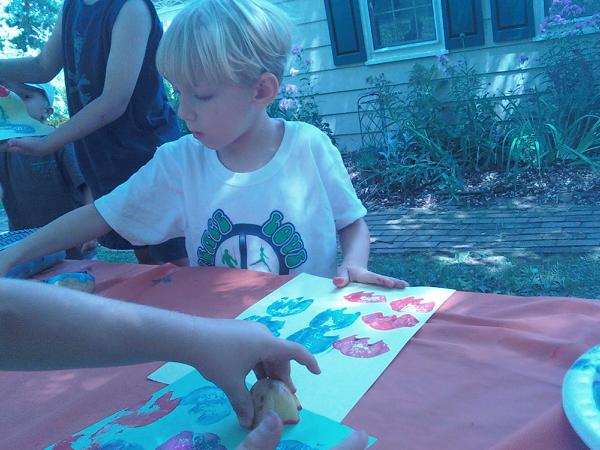
Potato print T-Rex tracks!


So cute! Facepaint compliment of the rocks from the stream


The 2nd dino canoe launch

Wednesday, August 3, 2011

Whittemore Camper Starts Dinosaur Journal!


The Dinosaur Canoe Adventures  
                                                ( summer part)
By Thomas C Larsen
This is how it started…we made a canoe.  We took a big log that had been laying around for a while.  Then we got some coal and put it in the middle of the log.  Then we lit it on fire.  If there is no wind, you have to blow on it to make it go, but don’t blow too much otherwise you’ll set the whole log on fire.  We let the coal burn maybe one hour and fifteen minutes.

Then you need a shovel to scrape out the ashes.  Then you need to do the same things again in the same place to make the hole deeper.  Put a dinosaur (plastic or something like that) in the hole you made with the coal.

Then find a medium size pond and take the canoe to it and put it in the water and push it off.  By the way this is a small size canoe not a big canoe.  A person cannot fit on it, it would sink.  If you want to get it back you need a stick or something to get it back.

Now for the adventure part!    We put the canoe in the pond, Friday, July 1st.   We went back on August 1st and it is still there.  So here is what I think it has been doing. 

It has been floating around the pond.  There is something that squirts water in the pond that makes it move around the pond.  The dinosaur has probably hit the shore a few times. 

I think the dinosaur got out of the canoe and got some food.  He got a lot of leaves maybe up to a million and packed it in his canoe.  Then he set off for Dinosaur Island.  It took him twelve days to get to Dinosaur Island!  When he got off, he was chased by meat eaters.  He realized while he was running he was on the wrong side of the island!  He ran around the meat eater side of the island twice all the while being chased.  Then he had an idea!  He could jump on the meat eater’s backs and heads.  Then he got back to his canoe and escaped.  He rode to the other side of the island.  Now he was on the right side of the island.  Whew!The End!  
The Launch July 1st, 2011
               

Leaving behind a trail of mud

Heading towards Dino Island...

August 1st, 2011. The canoe is still floating around! We NEVER touched it. The first canoe is in the back behind the fountain and the new canoe we launched July 29th is in the front